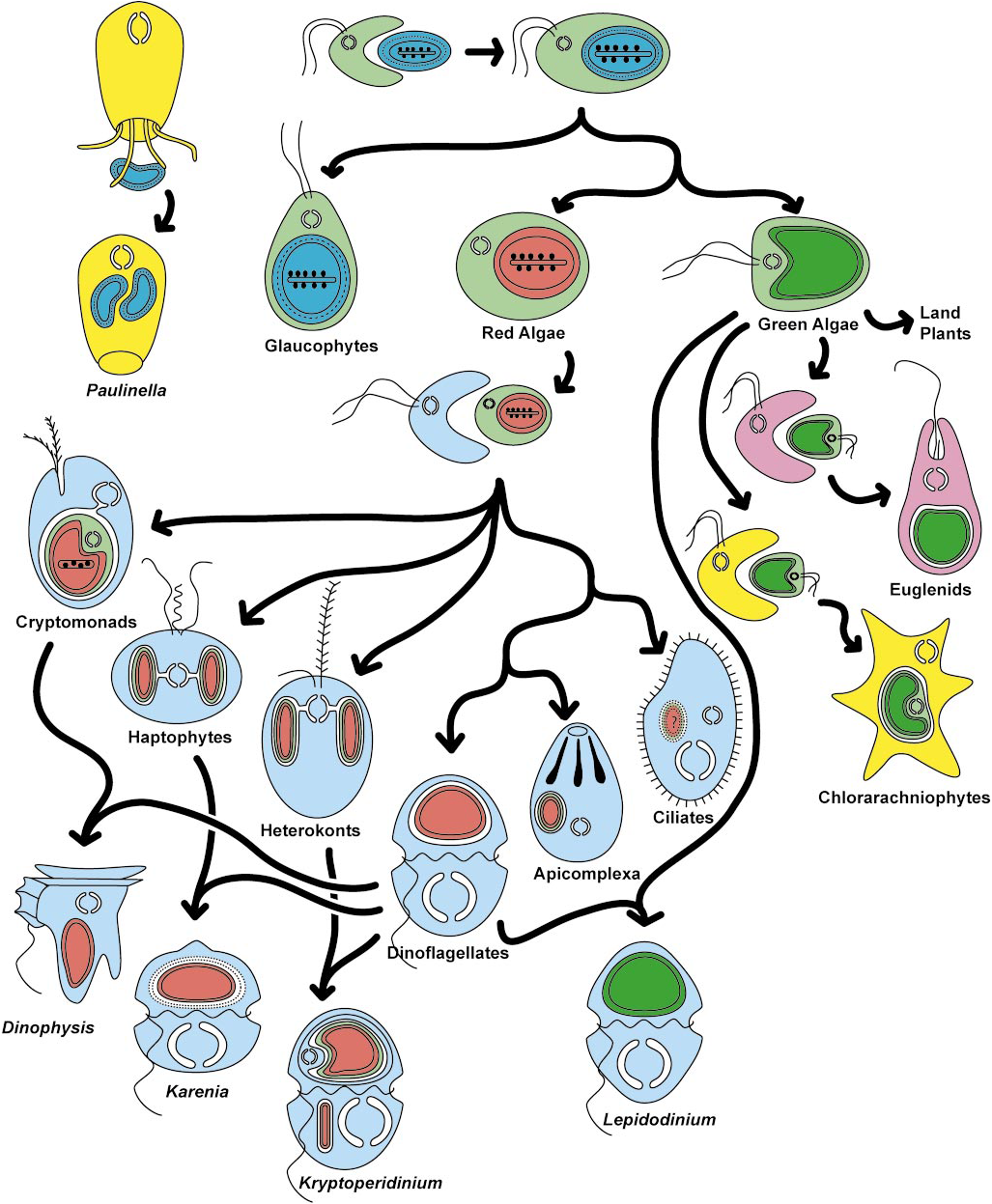
The evolutionary history of plastids, shaped by a series of endosymbiotic events. Plastids came to be when a free-living cyanobacterium was engulfed by a non-photisynthetic protist (a so-called primary endosymbiotic event). The bacterium becomes an organelle after a gene exchange between the nucleus and the prokaryote. Three main lineages diverged soonly after the inception of the eukaryotic algae: glaucophytes, red algae and green algae. The glaucophytes have a limited number of species, and didn’t give rise to any other algal group through secondary endosymbiosis. The green algae are a diverse lot, and eventually gave rise to land plants (Embryophyta). The rhodophytes are somewhat less diverse, but compared to the green algae, they have been more “productive”, in terms of new lineages. Only two new lineages originated from the green algae, whereas a myriad of diverse groups borrowed their plastids from the rhodophytes.
Thus, we can tell three main lines in the evolution of the eukaryotic phototrophs: blue, green and red. The majority of the algae is red, i.e., their origin point is an ancient red algae.
 On elephants and bacteria