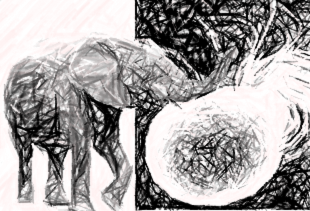
From roly-polies to trilobites, animals have been curling up the same way for millions of years. Simple behaviours sometimes evolve into entire lifestyles. From bugs to armadillos, thousands of animals today curl up; they are able to shape their bodies into a ball, becoming the ultimate defence strategy. Among all animals able to “roll”, arthropods…
Category: Zoology
Why do things keep evolving into ants?
Ants represent one of the most striking cases of convergent evolution on Earth. Thousands of species, from spiders to crickets have evolved to resemble ants through a process known as Myrmecomorphy. Myrmecomorphy takes different shapes: sometimes, insects are trying to enter an ant’s nest undetected, a strategy known as Wasmannian mimicry. In other cases, the goal is to fool a potential predator by looking like an ant, or Batesian mimicry. Why do animals evolve into ants?
Our croaky Gods: frogs across creational myths
Cultures around the world have created unique mythologies surrounding frogs. In ancient Egypt, Heqet and the Ogdoads were god frogs associated with fertility. For the Penobscot, a giant frog used to hoard all the water in the world, until a hero killed it and released the rivers. In ancient mongolian myths, Buddha was only able to create all elements with the help of a frog. Why do such different cultures have similar frog mythologies, always related to water, fertility or transformation? What does this tell us about humanities’ deepest worries and hopes?
Strangers in the animal tree (FINALE)
It has been a long while since the latest post in Onelephantsandbacteria, but we wanted to complete the series of Strangers in the Animal tree. That may represent a new renaissance on the blog, or at least, another small step to keep it alive. Animals are fascinating examples of life on Earth and their evolutionary…
Snouters and the lost world of Hyi-yi-yi: The scientific imaginary creatures (III): Snouters and the lost world of Hyi-yi-yi
Long ago, an archipelago in the Pacific Ocean was engulfed by the sea, and with it, all its inhabitants. There, the last of the snouters, or Rhinogradentia, a group of animals with large snouts, went extinct. This is what Gerold Steiner told us in his seminal work. But actually, none of this was real, but a giant science prank. Science is not always serious, and the history of science is full of scientists that used some of their time to fool their colleagues. Despite being completely false, the anatomy and lifestyle of the snouters is completely rooted in our understanding of evolution, an exercise known as speculative biology, where imagination and science intersect.
Life on Jupiter: is it possible? The scientific imaginary creatures (II)
It’s 1980. The decade of the 70’s has come to an end, and with it, a time when space travel seemed to be achievable in the near future. Fueled by Apolo’s XI landing in 1969, science fiction had just experienced a sudden rise that had even been promoted to the mainstream media (Star Trek, Star…
The history of the Caminalcules: the scientific imaginary creatures (I)
In On elephants and bacteria we always try to present unconventional theories, unique animals or just basically whatever has caught up our attention. In this new series of articles (we have not forgotten about Strangers in the animal tree….) we are going to look at the “pinnacle of imagination” in biology: the creation of scientific…
Seaweed for sceptics: ammonoids and brown algae
Welcome to the next issue of the Seaweed for Sceptics series. The first post of the series explored the rough origin of the red algae, showing the genetic impariment that these seaweed suffer as a result of their extreme origins. In this second post we shall focus on one of these weird connections that crop…
Strangers in the animal tree (P2)
We continue our series with some of the most strange and unknown animals on earth. In Strangers in the animal tree (Pt1) we got to known two monotypic phyla with mouth issues: Ciclyophorans, who are only found in the mouth of some common lobsters and Micrognathozoans, which have one of the most complex mandibles on…
Micrognathozoans and Cycliophorans-Strangers in the animal tree (I)
Animal diversity is stunning. Our planet is full of wonders beyond our imagination: animals that survive in the harshest of conditions, parasites that have become ultra-specialized, animals that use the sun for energy… the list has no end. We hardly ever wonder about the incredible diversity of creatures that live between us. It is in…
 On elephants and bacteria